Table of Contents
The countdown has officially ended, and the biggest sporting spectacle on earth is finally here. As the tournament kicks off across North America, millions of passionate football fans are searching for the absolute best way to experience every goal, yellow card, and dramatic penalty shootout.
Traditional cable networks and satellite feeds are rapidly becoming a relic of the past. They are expensive, heavily compressed, and tied down by rigid geographical broadcasting blackouts.
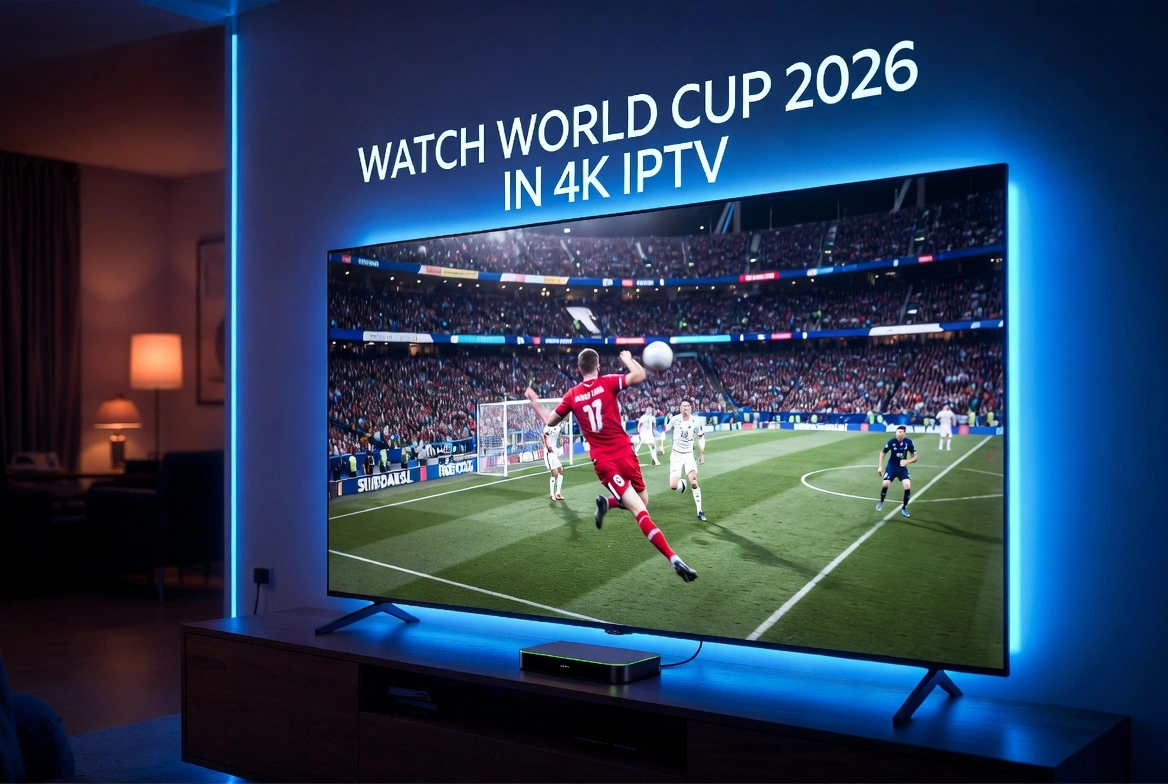
If you want the best possible seat in the house, learning how to Watch World Cup 2026 in 4K IPTV is the single greatest upgrade you can make to your home entertainment system.
[Stadium Camera Feed] ---> [Raw 4K UHD Capture] ---> [High-Bitrate Encoding]
                                                               |
    +----------------------------------------------------------+
    |
    v
[Premium Multi-Node CDN Network] ---> [Your Optimized IPTV Player] ---> [Smooth 4K 60fps Output]
But streaming a massive live global event in ultra-high definition puts incredible demands on your internet connection and playback hardware. It is not as simple as launching a generic web player and hoping for the best.
Without proper network configuration and high-tier server routing, a premium 4K video feed can easily devolve into an endless loop of freezing screens, macro-blocking, and audio desynchronization.
This comprehensive technical guide will walk you through the precise hardware choices, network protocols, software configurations, and optimization tweaks required to build a rock-solid, incredibly fluid home streaming setup.
The Shift from Cable to High-Bitrate Live Sports IPTV Streaming 60fps
For decades, traditional broadcast media was the undisputed king of live sports. However, satellite and over-the-air television transmissions operate under severe bandwidth limitations. To squeeze hundreds of channels into a single transmission spectrum, broadcast companies rely on heavy data compression. This strips away visual detail, leaving fast-moving objects like a kicked football looking blurry or surrounded by blocky digital artifacts.
Modern high-bitrate live sports IPTV streaming 60fps bypasses these old structural limits by routing video data directly through fiber-optic internet backbones. Instead of dropping the frame rate down to 25 or 30 frames per second to save bandwidth, a premium sports pipeline sends a continuous stream of 60 individual frames every second.
This matches the native motion of live human movement on a pitch. When a winger sprints down the sideline or a goalkeeper dives across the net, the motion blur is entirely minimized, providing a lifelike viewing experience that traditional cable cannot match.
Why You Need a Dedicated 4K Football Streaming IPTV Setup 2026
An ultra-high-definition (UHD) video frame contains exactly four times the number of pixels found in a standard 1080p Full HD image. This means your streaming device must process roughly 8.3 million pixels every single frame, 60 times a second.
If you are running an outdated or generic media setup, your device’s core processing unit will quickly max out its capacity, leading directly to dropped frames, application crashes, and severe stuttering.
Deploying a dedicated 4K football streaming IPTV setup 2026 configuration means optimizing every single link in your media delivery chain. It requires selecting a high-performance media processing chip, choosing connection protocols that minimize data overhead, and configuring your local system memory to hold an active video cache buffer.
By building a specialized, media-centric environment, you ensure your hardware has plenty of performance headroom to unpack heavy 4K data streams smoothly, keeping your picture crisp and pristine through long viewing sessions.
Finding the Best IPTV Service for FIFA World Cup 2026
Even if you own the most powerful smart television on the market, your viewing quality will ultimately be limited by the quality of your incoming stream feed. Finding the best IPTV service for FIFA World Cup 2026 means looking past flashy marketing claims and examining the technical framework of a provider’s backend servers.
[Incoming Viewer Requests] ---> [Load Balancer Network]
                                       |
           +---------------------------+---------------------------+
           |                                                       |
[Dedicated Sports Cluster Node A]                       [Dedicated Sports Cluster Node B]
   - Anti-Freeze Scripts Enabled                           - Anti-Freeze Scripts Enabled
   - 10Gbps Network Port Connection                        - 10Gbps Network Port Connection
Decoding the Architecture of the Best IPTV Provider for Sports
A standard, low-tier provider typically buys a single, low-capacity virtual server instance and crams thousands of active user accounts onto it. When a major match starts and thousands of viewers connect to the exact same channel link at the same time, the server’s network card chokes under the data load, causing the stream to buffer globally for everyone connected.
The best IPTV provider for sports operates on a radically different infrastructure. They run a distributed array of high-capacity bare-metal servers located inside major Tier-1 data centers. These servers are hooked directly into massive 10Gbps or 40Gbps internet pipes and utilize automated load-balancing software.
When you click on a channel, the load balancer checks your physical location and network conditions, then instantly pairs your device with the closest, least-congested server node available. This ensures that even during peak global viewing hours, your connection remains entirely stable and fast.
Finding the Best IPTV Service for 4K Streaming and Sports 2026
When evaluating options for the best iptv service for 4k streaming and sports 2026, there are three critical technical pillars you must look for:
- True Source Streams: The provider should pull their feeds directly from the stadium satellite or fiber source without re-encoding or compressing the video down to lower bitrates.
- High Concurrent Bandwidth: The server network must have guaranteed, unmetered bandwidth allocations to ensure 4K feeds do not drop in quality during high-traffic moments.
- Geographic CDN Diversity: The presence of edge nodes across North America, Europe, and Asia ensures that data packets don’t have to travel halfway around the world just to reach your device.
The Myth of Cheap Streams vs. Premium IPTV for Sports Channels
The market is flooded with ultra-cheap, budget services promising thousands of premium channels for next to nothing. However, running a true 4K streaming pipeline is an expensive technical operation that requires massive bandwidth and server maintenance. Budget providers cut corners by compressing their iptv for sports channels down to tiny bitrates, turning a 4K feed into a low-quality upscaled 720p image.
Investing in a premium best iptv service for sports means you are paying for dedicated network capacity and high-fidelity video feeds. These premium streams retain their high color accuracy, deep contrast levels, and sharp details, ensuring that when you Watch World Cup 2026 in 4K IPTV, your television panel actually displays a genuine, ultra-clear high-definition picture.
For those who want to test these settings with a high-bitrate, stable server that prioritizes dedicated sports routing, [check out the resources at getxtreamiptv.com].
Identifying a Genuine Anti-Freeze IPTV Server for World Cup Matches
A high-performance anti-freeze IPTV server for World Cup matches relies on smart software scripts running directly on the host server hardware. These custom scripts actively monitor incoming packet delivery rates for every connected user.
If a regional internet hub experiences a sudden traffic slowdown, the anti-freeze system instantly detects the drop and splits your video feed across secondary and tertiary backup streaming streams. This data redundancy happens completely behind the scenes in milliseconds, ensuring your player continues to render frames without a single pause or freeze on your screen.
Optimizing Hardware: The 4K Live Sports Stream Equipment Checklist
Unpacking a continuous 4K video stream running at 60 frames per second requires significant local processing power. Let’s look at the hardware choices and optimizations needed to maintain a smooth, responsive live sports stream environment.
| Hardware Type | Device Examples | 4K Decoding Efficiency | Suitability for Live Sports |
| Premium Media Box | Nvidia Shield Pro, Apple TV 4K | Exceptional (Dedicated ASIC GPU) | Ideal (Zero Frame Drops) |
| Mid-Range Streaming Stick | Fire TV Stick 4K Max, Chromecast | High (Hardware Accelerated) | Great (Requires Buffer Tweak) |
| Smart TV Onboard SoC | Samsung Tizen, LG webOS | Moderate (Shared System RAM) | Good (Requires Native App Optimization) |
| Legacy Android Boxes | Cheap Generic Android Boxes | Low (Software Emulated) | Poor (High Risk of Freezing) |
Smart TVs vs. Dedicated Media Streaming Boxes
While modern smart TVs are incredibly convenient, their built-in system-on-a-chip (SoC) processors are often underpowered compared to dedicated media boxes. A smart TV’s internal processor has to share its limited RAM and computing power with the core operating system, audio processing engines, and background telemetry tasks.
If you are running a heavy 4K live sports stream, an internal processor can easily overheat or run out of usable RAM, leading to sluggish menus and app instability.
For an optimal experience, running a dedicated media box like an Nvidia Shield TV Pro or an Amazon Fire TV Stick 4K Max is highly recommended. These specialized devices feature robust, dedicated graphic units explicitly wired to unpack dense video codecs like H.265 (HEVC) and AV1 at a hardware level. They handle heavy data streams with ease, ensuring your television panel receives a clean, uncompressed video signal.
Best IPTV Player for Samsung Smart TV World Cup Optimization (Tizen OS)
If you prefer to stream directly through an onboard Smart TV system without adding external streaming boxes, optimizing your software configuration is essential. This is especially true for Samsung Smart TVs running on the proprietary Tizen OS, which uses a completely different app environment than standard Android devices.
[Tizen OS Core Engine] ---> Bypasses Translation Layers ---> Links Directly to TV GPU
                                                                  |
                                                       [Smooth 4K Video Render]
When setting up your television, look specifically for native applications like IBO Player, Smart IPTV, or NetIPTV within the official Samsung App Store. These applications are compiled explicitly to talk directly to the Tizen OS media rendering engine.
By avoiding complex software translation layers, the best IPTV player for Samsung Smart TV World Cup viewing lets your TV’s onboard processing chip decode high-definition feeds efficiently. This leaves plenty of system memory open to keep your live sports broadcast completely stable.
Configuring the Right Software Media Engine for Low Latency IPTV for Live Sports
Inside the settings panel of high-end media applications like TiviMate Premium or IPTV Smarters Pro, you will find options for selecting your core media playback engine. Many players allow you to choose between a built-in standard engine or external engines like VLC or MX Player.
To secure a low latency IPTV for live sports setup, always select the player’s internal native engine and ensure Hardware Decoding (HW+) is fully enabled. Hardware decoding instructs the player app to send raw incoming video packets straight to your device’s GPU chip instead of letting the main CPU calculate the image mathematically via software. This drastically lowers system operating temperatures, keeps the app running fast, and cuts down channel-changing delays to less than a second.
Step-by-Step Tutorial: Setting Up Your Premium Sports Channels
With your hardware properly selected and optimized, let’s look at the actual software configuration. Getting your configuration right ensures your player maintains a direct, high-priority path to the live streaming servers.
🛑 Mid-Article System Check: Are Your Servers Prepared?
High-performance configurations require a rock-solid data foundation. If you want to make sure your system configuration is backed by ultra-dependable, low-latency sports channels built to handle high user loads, [head over to getxtreamiptv.com and secure your premium streaming line today].
Choosing Your Connection Protocol: Xtream Codes vs. M3U Playlist URLs
When linking your media player app to your provider’s backend database, you will usually be presented with two main connection choices: inputting a massive, complex M3U playlist URL or using your Xtream Codes API login credentials. Understanding the technical differences between these two transport methods is vital for long-term system stability.
An M3U playlist is simply a massive text document containing thousands of direct web paths to every single channel, movie, and TV show episode hosted on the provider’s server. When your player loads an M3U link, it must download this giant file directly into its temporary local RAM and parse every single line of text from scratch. This intensive process can easily overwhelm low-powered streaming sticks, leading to slow load times and app crashes.
Connecting via the Xtream Codes API sets up a fast, intelligent database link between your player and the server. Instead of forcing your app to ingest a giant text file, the API allows your player to quickly request only the specific channel categories you want to view right then. This keeps your local system storage clean, drastically speeds up initial channel buffering times, and ensures your application stays highly responsive during fast navigation.
How to Configure an Xtream Codes API Login for 4K Sports Channels
To configure your application using the optimized Xtream Codes protocol, open your player (such as TiviMate) and select Add Playlist, then choose Xtream Codes Login. Input the precise credential blocks provided to you in your subscription dashboard:
- Server URL: Input the designated domain routing path (e.g.,
[http://premium-cdn.com:8080](http://premium-cdn.com:8080)). - Username: Input your unique alphanumeric account identifier string.
- Password: Enter your matching secure user password string.
+--------------------------------------------------------+
|                  ADD XTREAM CODES PLAYLIST             |
+--------------------------------------------------------+
|                                                        |
|  Server URL:   [ http://premium-cdn.com:8080        ]  |
|                                                        |
|  Username:     [ your-unique-alphanumeric-string    ]  |
|                                                        |
|  Password:     [ ********************************   ]  |
|                                                        |
+--------------------------------------------------------+
| [X] Include EPG   [ ] Bypass SSL       [ SAVE / CONNECT ]|
+--------------------------------------------------------+
Check the box next to Include EPG if available, and hit save. Your player will query the server database and instantly map out your optimized sports categories.
Deploying an M3U Playlist URL for World Cup 2026 Matches Safely
If you are using an older legacy application that lacks an API input screen, you will need to link your system using the M3U playlist URL for World Cup 2026 matches option.
- Copy the long-format M3U string link from your service provider panel.
- Open your player app and select Add M3U Playlist Link.
- Paste the full text string carefully into the URL input box, ensuring no trailing empty blank spaces are left at the end of the line.
- Set the cache type parameter to Web/Remote rather than downloading the file locally, ensuring your channel paths stay updated if the host data servers move to new domains during the tournament.
Breaking Down Your Connection URL String
If you ever need to manually audit your connection link, a standard M3U string is built out of distinct, easily identifiable segments:
$$\text{http://[Server\_Domain]:[Port]/get.php?username=[Your\_User]\&password=[Your\_Pass]\&type=m3u\_plus\&output=ts}$$
- Server_Domain / Port: The specific digital address and open network gate used to access the host streaming servers.
- Username / Password: Your encrypted, unique identity markers used to clear firewall access.
- Type / Output: Tells the server to deliver a flexible formatting index (
m3u_plus) using high-priority live transport stream data chunks (output=ts).
Managing the Electronic Program Guide (EPG) to Never Miss a Kickoff
A live broadcast setup isn’t complete without an Electronic Program Guide (EPG). Running a proper EPG XMLTV setup for sports IPTV channels replaces generic “Stream-1” labels with an accurate, real-time breakdown of exactly what match is playing, kick-off countdowns, and panel discussions.
Your media player maps this data out by pulling down a structured XMLTV format text file from a remote web address. Inside your player’s settings, navigate to EPG Source or TV Guide Sources and paste your provider’s specific XML TV address.
Once linked, set the automatic update interval setting to Every 24 Hours or At App Startup. This ensures your guide data automatically syncs with any last-minute tournament scheduling shifts, ensuring you never miss a kickoff or post-match breakdown.
Advanced Troubleshooting: How to Fix IPTV Buffering During Live Football
Even with premium service and a great app, local network bottlenecks can still creep up on game day. If your stream starts dropping frames or stalling out, use these advanced troubleshooting steps to isolate and fix IPTV buffering during live football broadcasts before the referee blows the whistle.
Network Infrastructure: Defeating Wi-Fi Congestion with Wired Ethernet
When it comes to high-bitrate live streaming, raw download speed isn’t the only metric that matters. Network Latency and Jitter (the variance in packet arrival time) are just as critical. Wi-Fi is inherently prone to radio frequency interference. Microwaves, baby monitors, Bluetooth devices, and your neighbors’ wireless routers all compete for the exact same airwaves.
Wi-Fi Path:   [Server Data] --(Airwaves Interference)--> [Drops Packets] --> Buffering Loop
Ethernet Connection: [Server Data] ==========================> [Solid Copper Wire] ---> Zero Packet Loss
This wireless interference causes data packets to arrive out of order or drop entirely. When your player misses a packet, it pauses the video stream to request that specific piece again, causing a buffering loop.
Ditching wireless completely and running a physical, shielded Category 6 (Cat6) Ethernet cable connection straight from your router to your streaming device is one of the easiest ways to stabilize your stream. A wired copper connection drops your local packet loss down to zero and keeps your latency rock-solid, even when your neighborhood’s wireless spectrum is completely saturated.
Bypassing ISP Deep Packet Inspection (DPI) and Heavy Traffic Throttling
Many users don’t realize that their home internet provider might be actively working against them. During massive international sports broadcasts, local neighborhood internet networks face tremendous capacity strains. To prevent total regional slowdowns, Internet Service Providers (ISPs) often deploy automated network management software that uses Deep Packet Inspection (DPI).
[Your IPTV Stream Traffic]
          |
          v
[ISP Automated Firewall] ---> Analyzes packets using DPI
          |
          +---> [Detects Heavy IPTV Video Data] ---> THROTTLES SPEED TO 3 Mbps (Stream Buffers!)
          |
          +---> [Detects Encrypted Data Packet] ---> PASSES THROUGH AT 200 Mbps (Smooth 4K!)
DPI looks directly inside your incoming data packets to see where they are coming from and what type of content they contain. If the ISP’s automated firewall detects a massive, continuous stream of data chunks coming from an IPTV video server node, it will intentionally throttle your specific network port down to a crawl—often dropping your speed to just 2 or 3 Mbps.
To bypass this artificial speed cap, you need to use an encrypted connection path. Running a secure, high-speed virtual private network directly on your streaming device completely scrambles your data headers. Your ISP will only see generic incoming data, allowing your stream to pass through local network hubs smoothly at its full, unthrottled speed.
Fine-Tuning Storage: IPTV Buffer Size Configuration for Firestick 4K and Android TV
If you are stuck on a wireless connection or dealing with minor network fluctuations, you can compensate for it by manually editing your application’s memory profile. Inside the advanced playback settings panel of applications like TiviMate or IPTV Smarters, locate the IPTV buffer size configuration for Firestick 4K or Android TV systems.
[ Low Buffer (0 Sec) ] ---> [ Playhead ] -> No cushion. Any network dip instantly FREEZES stream.
[ High Buffer (5 Sec) ] ---> [=== Cache Cushion ===] ---> [ Playhead ] -> Absorbs network drops smoothly.
By default, many applications set their internal stream buffer to “None” or “0 Seconds” to make channel surfing feel instant. However, this means your player has absolutely no safety net if your internet speed drops for even a microsecond.
Change this setting to 3 Seconds, 5 Seconds, or set the buffer cache scale to Large (10MB – 15MB). This forces your player to keep a few seconds of video data pre-downloaded in its RAM. If your home network speed takes a quick dip, your player will seamlessly read from its pre-stored cache cushion, keeping your live match moving along without a single frame drop.
Custom DNS Routing for Instant Channel Zapping and Reduced Ping
Every time your streaming device tries to connect to your service provider’s video servers, it must first query a Domain Name System (DNS) server to convert the domain name text into a numeric IP address. By default, your streaming device uses the DNS servers provided by your local internet company. These local servers are frequently unoptimized, slow, and prone to routing data along congested paths.
Switching your streaming hardware over to a dedicated public DNS cluster allows you to secure a low latency IPTV for live sports pipeline. You can quickly adjust these network settings inside your Firestick, Smart TV, or main router dashboard by manually overriding your default DNS addresses to these highly reliable public options:
- Cloudflare DNS: Primary
1.1.1.1| Secondary1.0.0.1(Optimized for ultra-low latency) - Google Public DNS: Primary
8.8.8.8| Secondary8.8.4.4(Optimized for global routing speed)
Updating these routing points ensures your connection requests bypass slow local loops, reducing the time it takes for your device to open new streams and maintain a solid, steady connection to the match.
Conclusion: Elevate Your Home Living Room to a Premium Stadium Box
Prepping your entertainment system for a Watch World Cup 2026 in 4K IPTV setup might feel like a technical chore, but the payoff is immense. By moving past unoptimized apps and default network settings, you protect your living room setup from the massive traffic surges that disrupt lesser systems during high-profile matches.
The Ultimate Pre-Match System Checklist
To make sure everything is configured for optimal performance well before kickoff, run through this quick system check:
- Hardware Path: Is your streaming player linked to your router with a physical Ethernet cable?
- Software Configuration: Is your media player app set to use Hardware Decoding (HW)?
- Connection Framework: Have you linked your account via the fast Xtream Codes API rather than a bloated M3U text link?
- Memory Cushion: Have you set your internal playback buffer size to 3 or 5 seconds to absorb network dips?
- Data Routing: Have you updated your local DNS server to Cloudflare’s
1.1.1.1to ensure fast, efficient packet pathing?
Taking the time to dial in these adjustments transforms your home entertainment area into a dependable personal stadium box. You won’t have to deal with low-resolution video loops or frustrating buffering blocks while your neighbors are already celebrating a goal.
⚽ Ready for Kickoff?
Don’t wait for the opening match to find out if your setup can handle the strain of global traffic. If you want to pair your newly optimized hardware with a premium, high-bitrate streaming service featuring built-in anti-freeze server paths engineered specifically for major sports events, [head over to getxtreamiptv.com and secure your premium streaming line today].
Frequently Asked Questions (FAQ)
Can I watch the World Cup matches in true 4K resolution?
Yes, provided your streaming line allocation includes dedicated Ultra HD feeds. To enjoy true 4K video at 60fps without stalling, ensure your media player or Smart TV has the processing power to handle hardware-level HEVC/H.265 video decoding, and verify that your internet connection maintains a consistent download speed of at least 50 Mbps.
Why should I use Xtream Codes API instead of an M3U playlist link?
While both options connect you to your channels, the Xtream Codes API sets up a fast, dynamic database link. Rather than forcing your streaming device to download and read through a massive static M3U text file containing thousands of unnecessary links, the API requests only the specific categories you want to watch. This keeps your device’s memory clean and drastically speeds up channel loading.
What should I do if my stream buffer freezes during a live match?
First, eliminate local network fluctuations by connecting your device with a physical Ethernet cable instead of relying on Wi-Fi. Next, open your media player’s advanced settings and increase the internal Buffer Size or Stream Buffer to 3 or 5 seconds. This creates a helpful data cushion in your device’s memory to absorb minor network drops without pausing the broadcast.
Will my internet service provider (ISP) throttle my sports stream?
During massive global events like the World Cup, many ISPs use Deep Packet Inspection (DPI) to identify and intentionally slow down heavy video streaming traffic to save regional bandwidth. Using a secure routing network or encrypting your connection data caps helps mask your traffic signature, allowing your stream data to pass through local network hubs smoothly at its full speed.
Can I use my activation pass on multiple devices simultaneously?
Your premium stream line is directly tied to your account’s connection allocation. Standard configurations generally permit one active stream connection at a time unless you have specifically purchased a multi-room or multi-device package. Attempting to stream on two devices at once on a single-connection plan will cause a security conflict, resulting in immediate stream looping or logging you out of the server.
Leave a Reply